If your car's paintwork looks dull, hazy, or covered in fine scratches even though it's regularly washed, there's a good chance the problem isn't dirt. It's damage to the clear coat, the transparent top layer that gives your paint its gloss and depth. Paint correction is the process of removing that damage to restore the finish, and it's one of the most transformative things you can do for the appearance of your vehicle. But it's also one of the most misunderstood. This guide explains what paint correction actually involves, what kinds of defects it can fix, and how to tell whether your car needs it.
What Is Paint Correction?
Paint correction is the process of using a machine polisher and a series of abrasive compounds to remove a thin, controlled layer of clear coat, taking the defects with it. The goal is to level the surface so that light reflects evenly, restoring the depth and gloss that the paint had when it left the factory.
It's not the same as applying a polish or wax by hand. Hand polishing can mask minor imperfections temporarily, but it doesn't remove them. Paint correction physically removes the damaged layer to reveal clean, undamaged clear coat underneath. The difference is visible immediately and lasts until new damage is introduced.
What Defects Can Paint Correction Fix?
The most common defects that paint correction addresses are swirl marks, those fine circular scratches that are most visible on dark-coloured cars under direct sunlight. They're caused by poor washing technique, dirty cloths, automated car washes, and rough drying. Over time, they accumulate and turn a deep, glossy finish into something flat and tired.
Paint correction can also remove or significantly reduce light scratches, buffer trails left by poor machine polishing, water spot etching where mineral deposits have eaten into the clear coat, oxidation on older or neglected paintwork, and bird dropping or tree sap marks that have been left long enough to etch the surface.
What it cannot fix is damage that goes through the clear coat into the colour layer or the primer beneath. Deep scratches that catch your fingernail, stone chips, and areas where the clear coat has failed entirely are beyond what polishing can achieve. These need a respray or touch-up paint rather than correction.
How Do You Know If Your Car Needs Paint Correction?
The easiest test is to look at your paintwork under direct sunlight or a bright torch. If you can see a web of fine scratches, haziness, or a lack of clarity in the reflection, your clear coat has surface damage that correction can address.
Dark colours show defects most obviously, but lighter colours are just as affected. The damage is still there, it's just harder to see. If your white or silver car looks slightly dull or doesn't have the same pop it had when it was new, correction will bring it back.
Another sign is if you've been applying wax or sealant regularly but the finish still looks flat. Protection products sit on top of the clear coat. If the surface underneath is damaged, no amount of wax will restore the gloss. You need to fix the foundation before protection can do its job properly.
What Does the Process Involve?
A professional paint correction typically follows these stages. First, the vehicle is thoroughly washed and decontaminated to remove any bonded contaminants like tar, iron fallout, and industrial fallout. This is essential because polishing over contamination would drag it across the paint and cause further damage.
Next, the paintwork is assessed under specialist lighting to identify the type, depth, and distribution of defects. This determines which combination of compounds and pads will be used. Not every panel needs the same approach, and a good detailer will adapt their method across the car.
The correction itself is carried out using a dual-action or rotary machine polisher with progressively finer abrasive compounds. A cutting compound removes the bulk of the defects, followed by a finishing polish to refine the surface and maximise gloss. Each pass removes a tiny amount of clear coat, so precision matters. The goal is to remove just enough to eliminate the defect without thinning the clear coat unnecessarily.
Once correction is complete, the paint is wiped down with a panel wipe to remove any polish residue, and the true finish is revealed under inspection lighting. This is when the transformation is most dramatic: deep reflections, sharp lines, and a level of clarity that washing alone can never achieve.
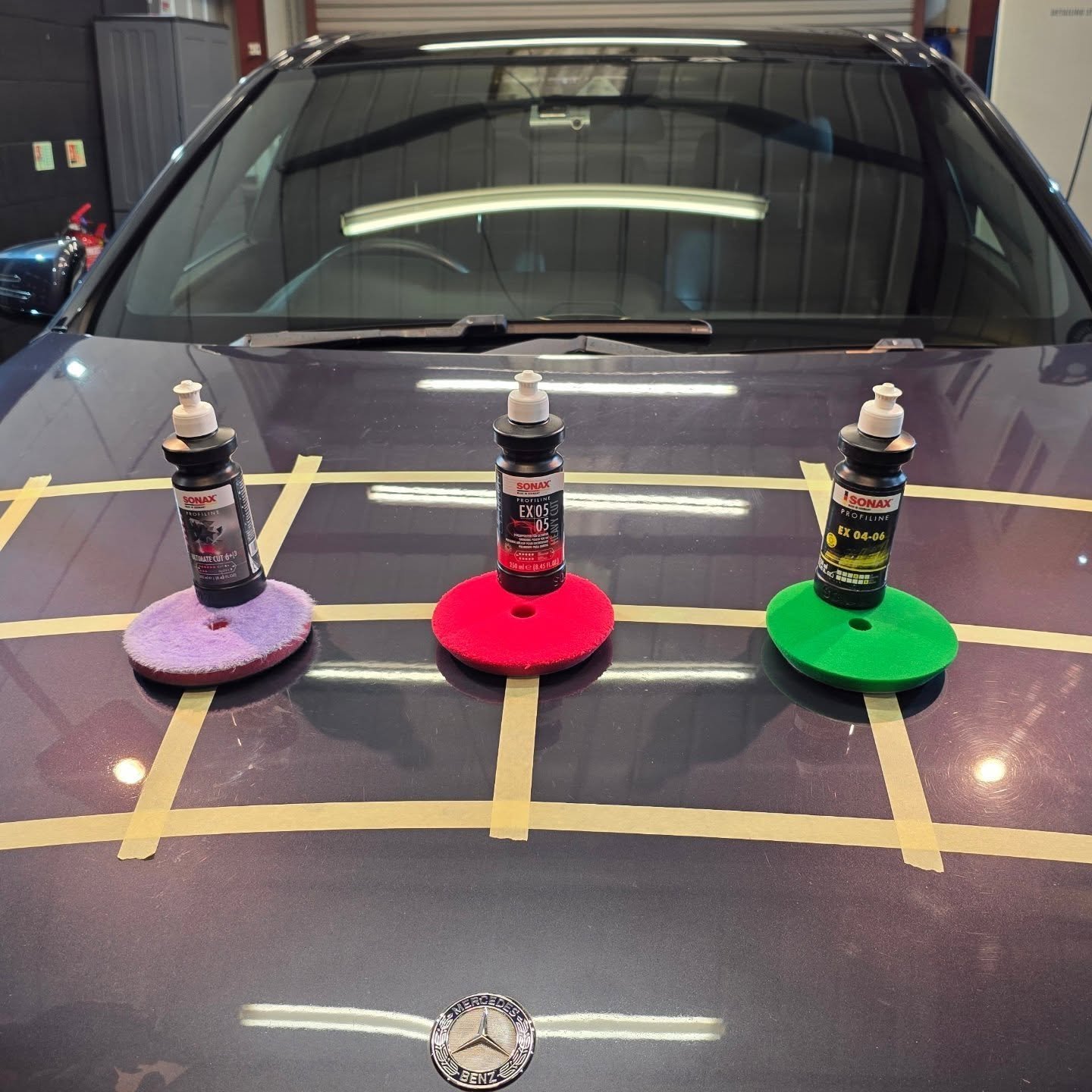
Every paint correction at LXC Detailing is carried out using Sonax Profiline professional compounds, with the right combination of product, pad, and technique selected for each panel based on paint type, hardness, and condition.
The Products Behind the Process
The compounds and polishes used during correction matter just as much as the technique. At LXC Detailing, we use the Sonax Profiline range, a professional-grade system designed specifically for machine polishing across different paint types and conditions.
For heavy cutting, where deeper scratches, sanding marks, or severe swirl damage need removing, we use Sonax Profiline CutMax. It's a high-performance abrasive paste that delivers strong correction with minimal matting, and its low-dust formulation means cleaner working and less residue on the surface. It's also silicone-free, which is important when preparing paintwork for ceramic coating application afterwards.
For medium correction and refinement, the Profiline ExCut 05-05 bridges the gap between heavy cutting and finishing. It handles moderate swirl marks and light scratches in a single step on many paint types, reducing the number of polishing stages needed without sacrificing quality.
The finishing stage uses Sonax Profiline Perfect Finish, a fine polish that removes any remaining micro-marring left by the cutting stage and brings the surface to full gloss. This is the step that produces the mirror-like reflections and depth of colour that make paint correction so visually dramatic.
On vehicles where the paintwork is in reasonable condition and only needs a single-stage correction, the Profiline Cut and Finish compound allows both cutting and finishing in one step, saving time while still delivering a high-quality result.
Every product in the Profiline range is developed for professional use and formulated to work with modern clear coat systems, including the harder ceramic-type clear coats increasingly used by manufacturers. Sonax publishes full ingredient breakdowns and safety data for every product in their range. The right combination of compound, pad, and technique is selected for each panel based on the paint type, hardness, and condition, because no two cars respond the same way.
Single-Stage vs Multi-Stage Correction
You'll sometimes hear paint correction described as single-stage or multi-stage. A single-stage correction uses one polishing step and will remove the majority of light swirl marks and minor scratches. It's a significant improvement for most vehicles and is the right choice if the paintwork is in reasonable condition but has lost its edge.
A multi-stage correction uses two or more polishing steps, starting with a heavier cut to remove deeper defects, then refining with finer compounds to bring the finish to its best. This is the route for heavily swirled or neglected paintwork, or for owners who want the absolute best result. It takes longer, but the difference is visible.
Can You Do Paint Correction Yourself?
In theory, yes. Dual-action polishers are available to buy, and there's no shortage of guides online. In practice, it's one of the riskier detailing tasks to attempt without experience. Too much pressure, the wrong pad and compound combination, or spending too long on one area can burn through the clear coat, and once it's gone, it's gone. There's no undo button.
Professional detailers develop their technique over hundreds of hours of practice. They know how different paint systems respond, they can read the surface under specialist lighting, and they adjust their approach panel by panel. If your car is something you care about, this is one job worth leaving to someone who does it every day.
What Happens After Correction?
Freshly corrected paint is in its most vulnerable state. The old layer of protection has been removed along with the defects, and the clean clear coat is exposed. This is the ideal time to apply a long-term protection product like a ceramic coating or a high-quality sealant.
A ceramic coating bonds chemically with the clear coat and provides a durable, hydrophobic layer that protects against UV damage, chemical etching, bird droppings, and environmental contaminants. It also makes the car easier to wash and keeps it looking cleaner for longer. Applying a coating to freshly corrected paint gives the best possible adhesion and longevity.
Even if you don't go for a full ceramic coating, applying a spray sealant or wax after correction will protect the finish and keep it looking sharp for longer. The key is not to leave corrected paint unprotected.
How Long Does Paint Correction Last?
The correction itself is permanent in the sense that the defects are physically removed, not filled or masked. But new damage will accumulate over time depending on how the car is washed and maintained. If you go back to a hand car wash the following week, the swirl marks will start to return.
The best way to maintain corrected paintwork is to use a safe wash method (pre-wash, two-bucket contact wash, rinse with clean water), avoid automated car washes entirely, and keep a protective layer on the surface. Regular professional valeting using proper techniques will keep the finish in excellent condition for years.
Is Paint Correction Right for Your Car?
If your paintwork has lost its depth and clarity, if you can see swirl marks or fine scratches under direct light, or if you're planning to apply a ceramic coating and want the best possible base, paint correction is the answer. It's the single most effective way to transform the appearance of your car without a respray.
Paint correction is assessed and quoted individually based on the size and condition of your vehicle. Every job is different, and we'll always be upfront about what's achievable and what it will cost before any work begins. Get in touch and we can assess the condition and recommend the best approach.
Not Sure Which Service You Need?
Find Out in 4 Questions
Answer a few questions about your car and we will recommend the right service, from a Full Valet through to a full ceramic coating.
Take the Quiz →Frequently Asked Questions
Paint correction is the process of using a machine polisher and abrasive compounds to remove a thin layer of clear coat, taking surface defects like swirl marks, scratches, and oxidation with it. It restores depth, gloss, and clarity to your paintwork.
Look at your paintwork under direct sunlight or a bright torch. If you can see a web of fine scratches, haziness, or a lack of clarity in the reflection, your clear coat has surface damage that correction can address. If your paint looks flat despite regular waxing, correction will restore the gloss.
A single-stage correction uses one polishing step and removes the majority of light swirl marks and minor scratches. A multi-stage correction uses two or more steps, starting with a heavier cut to remove deeper defects, then refining with finer compounds. Multi-stage is the route for heavily swirled or neglected paintwork.
The correction itself is permanent because the defects are physically removed, not filled or masked. However, new damage will accumulate over time depending on how the car is washed and maintained. Proper wash technique and a protective coating will keep corrected paintwork in excellent condition for years.
We use the Sonax Profiline range of professional polishing compounds. This includes CutMax for heavy cutting, ExCut 05-05 for medium correction, and Perfect Finish for final refinement. Sonax publishes full ingredient breakdowns and safety data for every product in their range.